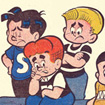
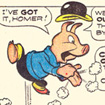
"George of the Jungle" is one of my all-time favorite cartoons. I wish they had made more than one season; but I suppose if Jay Ward had continued to make cartoons, the politically correct would have taken all the fun out of them. Ward probably would have had to water down Bullwinkle and the gang so they were just as bland as anything coming out of Hanna Barbera or Filmation in the 1970s.
Only two issues were produced by Gold Key. I always wonder how new books sometimes get killed so quickly...I assume more issues were planned, but only two were finished when the cartoon was cancelled (tie-ins usually only last the life of the show). One cool thing about these comics is that they are actually adaptations: the scripts were based on episodes from the series.
Walt Kelly's Pogo may have the biggest ensemble cast of any comic strip; it has a cast of thousands. (well, maybe not literally...a cast of hundreds, more likely) A relatively minor character could take center stage for a week or two: P. T. Bridgeport would come to the swamp, visit each of the characters in turn, and be the focus until he left. "Ol' Mouse" and Snavely the Snake, or the Three Bats (B. Witched, B. Othered, and B. Mildred) could hijack the strip from the main cast at any moment. Kelly was so good at creating these characters and writing funny dialogue, that many of them are fan favorites.
Albert and Pogo were always at the heart of the strip. But the "core" cast (Porkypine, Beauregard, Churchy and Howland, Albert and Pogo), feel like sort of a dysfunctional family unit. To me, anyway. Everyone will have their own favorites, but I am particularly fond of Churchy and Howland. With their goofy schemes and toothless battles, they don't need Albert around to be funny. And as far as owls and turtles go, you won't find too many designed as well as these two.
Here are a couple of stories from the last year of the Pogo Possum comic book.
"The Semi-Mental Gentlemints" from Pogo Possum #15 (Jan-March 1954):
"Greetings From Soup to Nuts" from Pogo Possum #16 (April-June 1954):
First, some general info...Choo Choo Charlie was the cartoon mascot for "Good & Plenty" candy (licorice with a crunchy candy coating). He appeared in commercials animated by UPA in the early 1960s. A full, comprehensive write-up (on Good & Plenty, and this comic) can be found at Scott Shaw!s fantastic Oddball Comics website: Oddball Comics #1198
You can even watch the old commercials on youtube:
This great old comic feels like one of Stanley's classic Little Lulu comics. Reading the dialog between Charlie and the unnamed little girl, they could easily be Lulu and Tubby. And I love how Stanley draws animals! I wish he had done a funny animal comic somewhere along the line, drawn in his own style. If there is a "funny animal" equivalent to say, Melvin Monster out there, please let me know!
You'll notice my copy has "5 cents" written on the cover...remember when you could find this stuff in a used bookstore for great prices? Not any more. I paid 4 bucks for this at a convention (which is still a deal, I guess, considering the other copies I saw were priced starting around $20). But I digress. I love/hate my expensive hobby.
Okay, enough talkin'! Here is Choo-Choo Charlie #1 (1969):
The more I reread this work, the more I'm convinced it should be collected. The recent collections of Fletcher Hanks and Boody Rogers are very nice, and soon we should be seeing a collection of Milt Gross' comic book work. A color collection of Briefer Frankenstein comics would fit right into that section of the bookshelf.
"Frankenstein Sees the Effect of the Youth Restorer" is the third of five stories from Frankenstein #4 (September-October 1946):
Alter Ego #41 ran some "Frankenstein" comic strips that Dick Briefer had drawn as a tryout (in the 1970s) for syndication. This werewolf story was one of the stories he adapted into those strips (another story from issue number 4, "Frankenstein and the Sorcerer", was also adapted into the strip...I will be uploading that story soon). 25 of his 61 tryout strips are reprinted over 5 pages. It also has an article on different versions of Frankenstein in the comics, some Alex Toth sketches of Briefer's Frankenstein, and a 2-page biography of Dick Briefer, written by Dick Briefer himself. Back issues are still available from Twomorrows: buy one here.
"Frankenstein Meets the (Terrible) Werewolf" is the second of five stories from Frankenstein #4 (September-October 1946):
More great Dick Briefer fun! This story has Frankenstein, the "Merry Monster", helping his friend Awful Annie, who lives "out near the garbage pile". Annie is depressed, and like a reanimated Fat Albert, Frankenstein decides to help. Good "Addams' Family" type gags in this one.
My copy of this issue was stapled from the top, near the spine. So the even-numbered pages may be a little distorted because the artwork goes right up to the crease in most cases. This first story didn't scan too badly, though.
This is the first of five stories in this issue.
Here is "Frankenstein and Awful Annie" from Frankenstein #4 (September-October 1946):
In his introduction to the first collection of his stories, Bob Bolling relates how he was given the freedom to create the world and supporting cast for Little Archie. The stories were comedies similar to the regular titles at first, but "soon, the story possibilities for Little Archie were endless and I got to relive my own boyhood fantasies through many of these tales. Who among us didn't dream of having a neighborhood clubhouse and building rafts and cars out of scrap lumber? Or wish we could go on fantastic adventures in exotic locales like a pirate ship, a wild West ranch,or even outer space?"
Here is "Plesiosaur" from Little Archie #20 (Fall 1961):
The Adventures of Little Archie (volume 1) contains 8 full stories, including "Little Archie on Mars", "Pirates", and "Robots of Doom" (the first appearance of recurring villain, Mad Doctor Doom):
I love splash pages...it's something you don't see much anymore, but you see them in just about all these old Frankenstein comics. Briefer's splashes are simple and effective.
An acknowledgment is given to "Bruce Elliott" for his help with the stories in this issue, but it doesn't specify what help was given. Inking? Plotting? Anyone out there familiar with Bruce Elliott?
I have to take issue with the cover's proclamation of "52 pages of action and fun"...there are only 43 pages of Frankenstein, the front cover, and a house ad (I'll allow that) for a total of 45 pages. 47 if you count the 2-page text story (I will but don't want to...it has nothing to do with Frankenstein. Pure filler). The rest are ads. The 52-page books were actually 48-page books, but with both sides of the front and back cover counted as additional pages. When Dell claimed 52 pages of comics, there were comics printed on those covers, not ads.
Still, it's a small complaint. A 52-page comic with no ads would probably run at least 7 or 8 bucks now, while this great old comic cost a dime.
By the way, I brightened up the scans of the first three stories, so you might want to take another look at them. I think I improved the readability a bit!
This is the last of four stories in this issue.
Here is "Frankenstein and the Time Machine" from Frankenstein #3 (July-August 1946):
This is a silly little story; I suspect Briefer just wanted to draw mummies. It does end with a nice visual punchline, though, unlike the first two stories in this issue. But seeing Frankenstein strolling the ship's deck in a suit, complete with straw hat and walking stick, is hilarious. Oh, and that establishing shot of Egypt is a hoot.
This is the third of four stories in this issue.
Here is "Frankenstein and the Mummies" from Frankenstein #3 (July-August 1946):
Jugend magazine gallery
-
How much more fabulous can it get? There’s a whole website devoted to the
magazine Jugend (19th century and early 20th century), with galleries of
covers, ...
Throwaway Sunday
-
Panels from Beetle Bailey, 11/8/09 Here you are, ladies and gentlemen: the
most throwawayable thowaway panels in the history of the comics. Carefully
desig...
-
Number 625
The comic book civics lesson
If a United States senator is having a tough time getting his bill passed
through the regular American lawmakin...
Moomph
-
What's a Sunday without a Sunday Pogo?
Here's the scoop: I've got a lot of Pogo Sundays, that I clipped from the
newspaper, from 1963 through the early 70s...
Stumbo the Giant in "Giant Removal Project"
-
This *Stumbo the Giant* story goes out by request to my friend, Chuck Wells,
at The Comic Book Catacombs. Mr. Wells is clearly a man of discriminating
tast...
Are you pleased?
-
Friday comes once again, and so does your daily comics
reviews/commentary/whatever. You should probably be pleased.
Beetle Bailey, 11/6/09
Wouldn't that j...
The Giant Makers
-
Freedom Agent lasted exactly one issue. Here is the cover story by *Alberto
Giolitti*, who did the penciling and inking throughout. I would bet dollars
to ...
Super-Pop Blain
-
Christophe Blain is, perhaps, the best and more influential european
cartoonist of our days. I can't think of another contemporary cartoonist
working comic...
-
*The Tall Target*'s Ticket To Ride
I’m being really obscure here, but couldn’t resist posting these just found
ads for key city first-runs of *The T...
“Mike’s Kryptonite”
-
[image: Comic]
I hope you’ve liked the black and white strips so far, I will be doing color
too again but right now I am having fun experimenting! Let me ...
John Stanley's New Yorker Cartoon, 3/15/1947
-
Thanks to Jeet Heer and James Gill for helping me locate this one-off shot
at the Big Time for our hero, John Stanley.
Alas, it's from the well-intentioned...
Hotess Heroes Presents: The Flash versus Old Dudes
-
The Flash in "Marathon Madman"
The Flash is the Fastest Man Alive, according to the teensy little words
which appear underneath his name, and yet his Hostes...
San Diego Comic-Con + Monsters of Webcomics
-
My "Clumsy Love" Comic-con 2009 strip!
My brother Doug and I doing sketches for donations to the Cartoon Art
Museum!
Me and the great Gene Colan!
M...
Half-Pint Pygmy (1948)
-
Now here's a truly weird cartoon even by Tex Avery's standards. *"Half-Pint
Pygmy"* (release date: 8/17/1948) is one of Avery's less known and rarely
seen...